
Written by Sam Johnson
The US Geological Survey (USGS) just released its 2025 Critical Mineral list, highlighting vital resources to US economic growth and technological leadership. One of 2025’s new additions was phosphate, a key raw material in fertilizer production. Vital to the agricultural industry, phosphorus can cause critical failures in wastewater treatment processes, leading plants like Red Deer, Alberta, Canada, to find a simpler solution with NuReSys and Schwing Bioset.
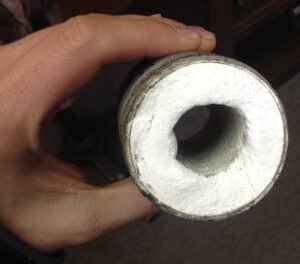
Struvite build-up in a pipe.
Phosphate can be found in abundance in many wastewater treatment processes. Under the right circumstances – or “wrong,” if you ask any experienced wastewater professional – it can precipitate and form Magnesium Ammonium Phosphate (MAP), better known as struvite.
It builds up in pipes and equipment like cholesterol in an artery, lowering plant capacity, increasing maintenance and energy usage, and costing a plant precious time, efficiency, and resources.
Struvite was forming in the Red Deer Wastewater Treatment Plant’s four sludge lagoons when phosphorus was released from settling biosolids, then recycling the phosphorus-rich water through the headworks.
Schwing Bioset has a long history in Alberta. In 2000, Edmonton installed a piston pump and sliding frame and has since undergone several expansions and projects, adding more SBI equipment. In 2016, Calgary installed a truck-loading sliding frame and conveyor system, modeled after the success of Edmonton’s system.
Red Deer, located halfway between the two cities, followed suit, installing a container wagon system in 2019. In 2021, Red Deer and its project partner, Stantec, began searching for their next solution.
In an article with Environmental Science & Engineering, Andria Klatt, environmental planning engineer for the City of Red Deer’s utility services, said the plant “needed a treatment process to reduce phosphorus recycling to save on equipment replacement costs.”
There are many ways to battle struvite buildup. Plants might resort to chemical flushing, hydrojetting, replacing pipes, and other temporary fixes; an operator might even chisel away at buildup with a screwdriver in a pinch. But, few options stop struvite in its tracks, prevent future buildups, and achieve beneficial reuse of the critical mineral.
Stantec conducted a master plan and feasibility study. After seeking out improvements to combat struvite buildup, protect infrastructure, and provide capital savings for future upgrades, the Nutrient Management Facility (NMF) was born.
Stantec and Red Deer replaced one of the bioreactor cells from the original biological nutrient removal plant and began building the NMF. The 540M2 building will hold the NuReSys process tanks, bagging, and storage areas.
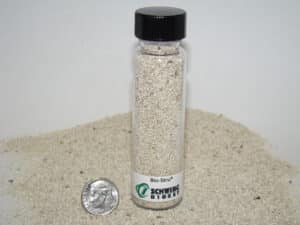
Bio-Stru is a marketable fetilizer produced by NuReSys Integrated Phosphorus Management technology.
NuReSys (Nutrient Recovery Systems) technology fits into a wide variety of plants and can process centrate, digestrate, or a mixture of both. It achieves all of Red Deer’s goals, breaking the phosphorus recycling stream and providing a range of additional benefits to the plant.
It reduces buildup, clogging, and accumulation in pipes, pumps, centrifuges, and other equipment, increasing capacity and efficiency while cutting shutdown and maintenance costs.
Stantec and Red Deer already determined the need for a phosphorus recovery system. In NuReSys, they’re receiving a fully automated, continuous, precise, and customizable system that provides not just savings, but profits by producing Bio-Stru®, a high-value, slow-release marketable phosphate fertilizer.
NuReSys had seen success around Europe before entering the North American market with its first continental installment at the Tres Rios Water Reclamation Facility in Arizona, where it converts available orthophosphate into crystalline form, successfully breaking the phosphorus recycle stream.
Red Deer will join Tres Rios and other facilities around the world in making the leap from reactive to proactive struvite strategies with Schwing Bioset & NuReSys’s integrated phosphorus management strategy.

North America’s first NuReSys installation at the Tres Rios Water Reclamation Facility in Pima County, AZ.
Learn more by clicking the buttons below or by following us on LinkedIn and Facebook!


More about NuReSys:
NuReSys, headquartered in Belgium, is a leader in the recovery of nutrients like Phosphorus and Nitrogen from wastewater and solid streams, converting these recovered crystals into high-value, slow-release, phosphate fertilizer, Bio-Stru®. Leveraging our patented Integrated Phosphate Management (IPM) technology, our mission is to optimize nutrient reuse, which would have otherwise entered local waterways and harmed the environment. We collaborate with various clients, including industries and municipalities, to develop customized wastewater treatment solutions.